
Automating Instagram DMs: the 4 penalties Meta actually hands out
Most people never start automating their DMs because they are afraid of losing the account. 👀 The fear is real. It is just pointed at the wrong thing. 🙌
The short answer
Permanent bans for messaging automation are rare. Temporary blocks are common. And what decides which one you get is not your software — it is the way you use it.
In this article, you get the exact text Meta publishes, the 4 rungs of enforcement, the 5 behaviours that really decide, and the 2 scenarios that show where the line falls.
What does Instagram actually prohibit?
Go and read the text. It is public, and almost nobody quotes it correctly. 😮
First trap, and it is a big one: most articles on this subject send you to Facebook's terms of service. Meta says in its own preamble that your use of Instagram is governed by the Instagram Terms of Use — a different document. 👀
The section headed "How you can't use Instagram" contains 9 prohibitions. Most articles quote none of them. We are going to quote the 3 that decide.
The first one goes straight at automation: creating accounts, accessing information or collecting it by automated means, without express permission — whether you are logged in or not. 3 things are named there. Account creation, access, collection. Scraping and fake accounts. 💡
Message sending is not among them. And it is not in the 2 other documents people usually reach for either. The spam policy targets "posting, sharing, engaging with content or creating accounts". The Automated Data Collection Terms cover, as the name says, collection.
This is an awkward fact for everyone in this market, us included: nowhere does Meta name automated private messaging. Which does not stop accounts from being restricted every single day. So what is catching them?
2 other points in the same section. They are the ones doing the work. ⚠️
The interference clause: you may not do anything that interferes with the intended operation of the service.
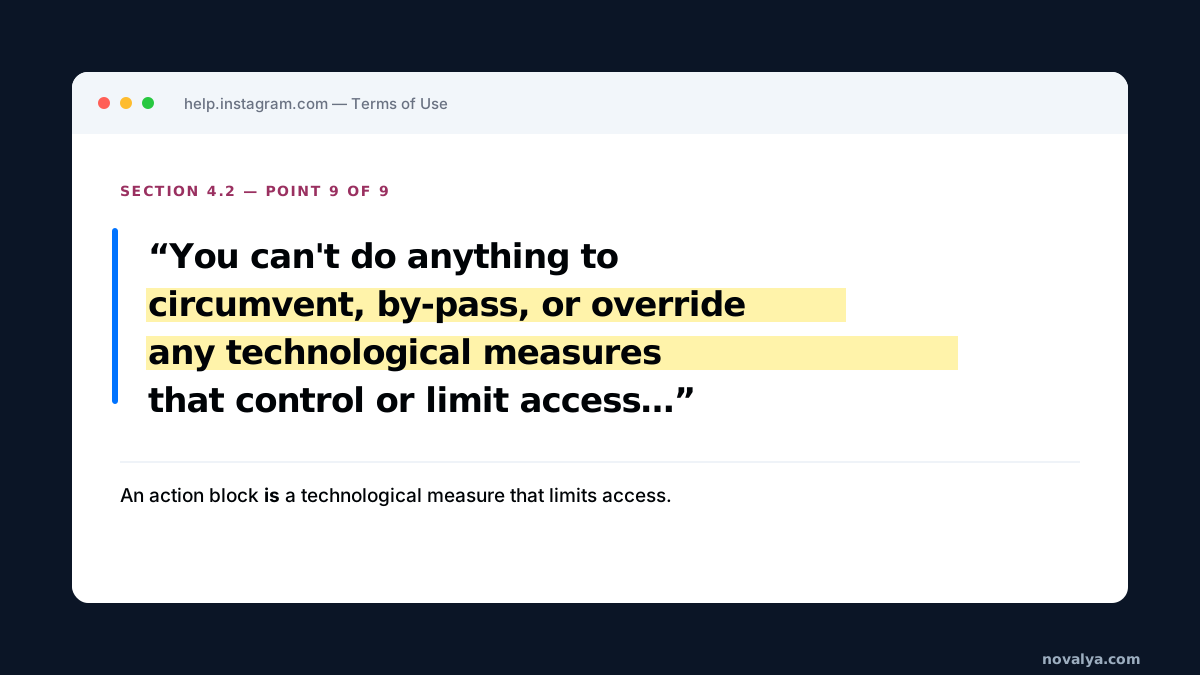
The circumvention clause: you may not attempt to circumvent or override any technological measures that control or limit access to the Service or data.
That is the real gate. An action block, a rate limit, a quota — those are technological measures that limit access. ⭐
Anything built to get past one of them falls under the circumvention clause. And you will not find that written anywhere else on the English-speaking web.
Section 4.2 of the Instagram Terms of Use. It is the clause nobody quotes, and it is the one that decides.
That leaves the spam policy, which describes the behaviour being punished: acting "either manually or automatically, at very high frequencies".
Manually or automatically. 2 words that change the whole question, because they move the subject. Meta is not judging the tool. It is judging what the account does.
Meta does not look at your software. It looks at how fast your account acts, and how alike the messages it sends are.
A human sending 100 identical messages in an hour is treated exactly like a bot. Software sending 20 personal ones across a day looks like a human.
That is also why the thresholds you see everywhere — 50 a day, 200 an hour — come from nowhere. Meta has never published a figure. The rule does not run on numbers. It runs on behaviour.
Which tools circumvent, and which ones only slow you down?
The circumvention clause splits this market in 2, and nobody talks about it. 🔍
The ones that circumvent. One very well known European competitor explains on its own security page that its software intercepts the signal sent to the platform and replaces it with a message saying the user is running no forbidden extension. The platform, it promises, will never know. The same page sells a feature to go past the official quota: 2,500 invitations a month where the platform allows 800.
Neutralising a detection. Exceeding a published limit. That is the literal definition of the circumvention clause, sold as a product benefit. 🤯
The ones that slow you down. The other approach touches no technological measure at all. It works on a single variable: pace. Space the sends out, cap the volume, vary the wording, never write twice to the same person.
That is where Novalya sits, and you can check it. We intercept no signal, we hide nothing from the platform, and we will never offer you a way past a limit Instagram has published. Our settings exist to keep you underneath it.
The difference is not a moral one, it is practical. A tool that neutralises a detection exposes you to a clause written in black and white in the contract you accepted. A tool that slows you down exposes you only to your own behaviour — and that one you control.
What do people get wrong about Instagram automation?
Type the question into Google and the same claims come back on every page. Not one of them holds up. 🔍
Myth 1 — "The limit is 50 DMs a day."
That number exists nowhere. Not in the Instagram terms, not in the spam policy, not in the help centre. Not 50, not 100, not 20.
Someone invented it, a blog copied it, then 50 more blogs copied that blog. 🤯
And it is wrong in both directions. 50 identical messages from a 3-week-old account is already too much. 100 personal messages from a 3-year-old account go through without setting anything off.
A single number cannot exist, for the simple reason that the rule does not judge the count. It judges the behaviour.
Myth 2 — "Official tools are safe, extensions get you banned."
This one is half true, and the missing half is the important one.
Official partners do exist. ManyChat, for instance, presents itself as an Official Meta Business Partner, and it works through the Instagram Messaging API — the interface Meta opens up to businesses.
Except that API does exactly one thing. Meta's policy is explicit: a business has 24 hours to reply to a user.
Reply. The official route exists to handle the people who wrote to you first. It does not let you approach someone who never contacted you.
So nobody is "approved" for cold DMs. Not because it is permitted for some and forbidden for others, but because the official route does not do it at all. ⚠️
If a tool promises you cold DMs approved by Meta, ask it for the link. Us included. 😉
Myth 3 — "One block and my account is marked for life."
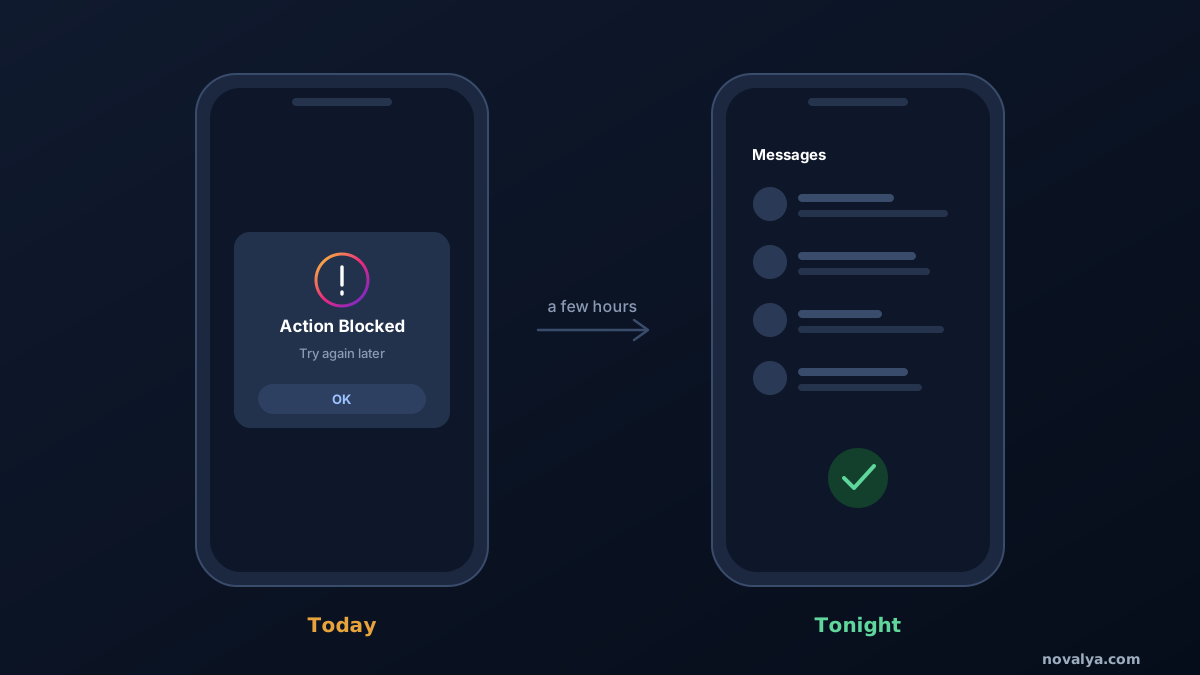
An action block lasting a few hours leaves nothing usable behind. It is rung 1, it happens to millions of accounts, and it lifts on its own.
So what counts is not the block itself. It is what you do in the 24 hours that follow.
What happens when Instagram decides you went too far?
Meta does not publish its enforcement grid. But what users report draws a very clear escalation, and the heavy measures never arrive first.
The action block
By far the most common case: one feature stops for a few hours and you see "Action blocked" or "Try again later".
Nothing is lost and nothing stays on your record. You wait, it comes back.
The longer restriction
Days instead of hours, and it lands almost always for the same reason: you went straight back to the same pace the minute the first block lifted.
Feature removal
You lose the ability to message non-followers, while the rest of the account keeps working normally.
The disabled account
The one everybody fears, and the rarest of all for messaging.
When it does land, it is almost never a single bad day. It is a pattern settled in over weeks, or it is something other than volume — a wave of reports, a purchased account, evasion after several blocks.
Remember this above all: 3 of those 4 rungs are reversible, and you have to walk past several warnings to reach the last one.
Instagram warns you, in other words. And it warns you more than once before it hits hard. ✅
The block itself — what it looks like, what else besides messaging can trigger it, how long it typically lasts — is its own subject: Instagram "Action Blocked": what it actually means.
What decides whether your account gets restricted?
Here is what really separates a quiet account from one that keeps getting hit.
The age and history of the account
An account opened last week that sends 50 cold DMs ticks every box in the spam policy: high frequency, no history, repetitive content.
An account with 2 years of real activity behind it has enormous room by comparison.
And if you are thinking of buying a clean account to protect your own, understand that you are picking the riskiest option, not the safest. An account with no past is the most detectable profile there is.
How alike your messages are
Pasting the same text to 100 people takes no effort at all to spot.
And it is not evasion tricks that fix this. Not special characters, not deliberate typos. Real variation.
Above all: a first line that could only have been written for that one person. That is the only place personalisation is genuinely visible. We put together 7 first-DM templates that actually get a reply.
What your recipients do
The most underestimated factor on the list. 👇
Being ignored costs you nothing, while being reported costs you a great deal.
A message that makes someone want to press "report" is dangerous at any volume. A message that opens conversations is safe at volumes that would look aggressive on paper.
Your reply rate is, quite literally, your safety margin.
Pace
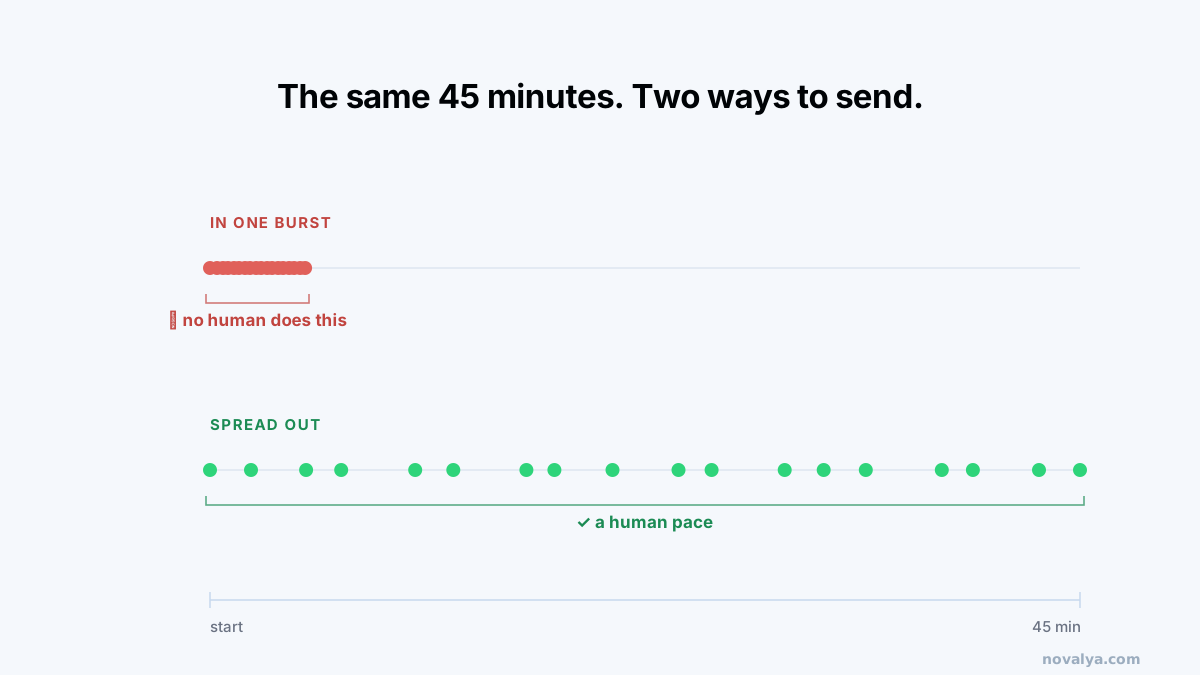
30 messages sent in 2 minutes is not a human pattern, while the same 30 spread across a day go completely unnoticed.
Bursts show up far more than totals.
Bursts, not totals
The same messages, sent in the same amount of time, read completely differently depending on how they are spaced. Bursts get noticed. Totals do not.
That is why there is no simple answer to how many DMs you can send on Instagram per day.
How you react after a block
The behaviour that separates a nuisance from a real problem.
You stop, you wait, and you come back more slowly? You are fine.
You switch device, network or account to keep going during the block? That reads as deliberate circumvention, and that is where it gets worse fast.
You just got blocked: what should you do now?
An action block is not a disaster. It is a warning, and it can be handled. Here is what we recommend doing — and above all, what not to do.
Day 1 — You stop everything.
Not just the automation. Manual DMs too, because the block is on the account and not on the software.
Do not change wifi network. Do not switch to mobile data. Do not log in from another device to check whether it works.
Every one of those looks like an attempt to get around the block — and that is precisely what turns rung 1 into rung 2.
Day 2 — You use the account normally.
You scroll, you like, you answer the conversations already open. An account that goes completely silent for a week and then restarts at full speed is far more suspicious than one that keeps living.
Day 3 — You come back at half.
If you were at 40 messages a day before the block, restart at 20 and spread them out, then watch what happens for 3 days.
After that — you climb slowly, or you do not climb.
If 20 go through cleanly for a week, move up to 25. But if a second block lands, your problem is no longer your volume, it is your message. Go back and rewrite it. 🎯
Where exactly does the line fall?
The version that breaks
100 identical pitches a day, from an account opened last month, to strangers who asked for nothing.
You will have problems, and no tool on earth will get you out of them.
The version that holds
20 personal messages a day, from a real account, to people with a genuine reason to hear from you.
You are doing what the platform sees millions of times a day, with no way to tell it apart from ordinary use. Because it is ordinary use.
So the real line does not run between "manual" and "automated". It runs between a message someone wants to read and a message someone wants to report.
What can software hold in your place?
A tool will never make you interesting. But it holds the guardrails nobody holds at 11pm, when the list is still long:
- A volume decided in advance, not in the heat of the moment.
- Spacing between sends, so 30 messages do not go out in 2 minutes.
- Message text selected automatically from several variants, instead of staying fixed.
- Detection of open conversations, so you do not write again to someone you are already talking to.
If you are still weighing which one to use, tools used for Instagram prospecting are all built around the same 3 jobs — finding, sending, tracking. What separates a safer one is exactly the list above.
Every Novalya plan sets a monthly cap, which you choose when you subscribe. That cap is not Instagram's limit — it is the range we are willing to put our name on, for a normal account with a normal history, messages spread out and never fired off in one block. The figures live on the pricing page, the only source that stays current when the plans move.
Send Personalized DMs varies the text and spaces out the departures. Instagram automation is set by pace, not by volume.
What no tool will do for you is make your message worth receiving. If your first DM is a pitch, you will collect reports whatever the software does — and reports are what get accounts restricted.
In short
- Meta names automated message sending nowhere. What catches you is the circumvention clause (section 4.2 of the terms) and the spam policy (frequency). The behaviour, never the tool.
- 4 rungs, 3 of them reversible. A disabled account is the last one, and you have to ignore several warnings to get there.
- Circumventing is not slowing down. Neutralising a detection or exceeding a published quota falls under a written clause. Spacing your sends does not.
- 5 factors decide it: the age of the account, the variation in your messages, the reports you collect, your pace, and how you react after a block.
- Your reply rate is your safety margin. An ignored message costs nothing. A reported one costs a lot.
Frequently asked questions
Can Instagram detect that I am using software?
Nobody can state that from the outside — be wary of anyone who claims otherwise, in either direction. What the published texts do let us say is this: the rule that applies does not mention tools. It talks about frequency and repetition.
How many DMs can I send per day?
Instagram publishes no figure, and the thresholds in circulation are sourced nowhere. We go into it in detail elsewhere: how many DMs you can send on Instagram per day, and what makes your margin move.
I just got 'Action blocked'. What do I do?
You stop. You wait for it to lift. You come back more slowly. What turns a nuisance into a real problem is restarting at the same pace, or switching device to keep going during the block.
Can a brand-new account automate its messages?
It is the worst possible moment to start: an account with no history is the most detectable profile there is. If you are just beginning, how to find and message prospects in a Facebook group asks for far less seniority than a cold Instagram DM.
Does going through an official Meta partner make cold DMs safe?
No, because the official route does not do cold DMs at all. The Messaging API gives a business 24 hours to reply to someone who wrote first. There is no approved path for contacting a stranger who never messaged you.
Read next
- IInstagram OutreachInstagram "Action Blocked": what it actually meansWhy Instagram shows "Action Blocked", what can trigger it, how long it lasts, and whether it means your account is banned.
- IInstagram OutreachHow many DMs can you send on Instagram per day?Instagram doesn't publish one fixed daily DM number. See the 6 signals that shape your limit, the warning signs, and what to do before restrictions hit.
- FFacebook OutreachHow to find clients on Facebook without running adsSix ways to get clients on Facebook without an ad budget — where to find people, what to send first, and how to keep track of the conversations.