
First message: 7 openers that actually get a reply
Most people freeze on the first message because they think it has to sell something. 👀
The short answer
A first message has exactly one job: get a reply. Not a sale, not a booked call, not a click. And what makes people reply is not the template — it is the variable you fill in yourself.
One conversation you are actually in is worth more than a hundred you opened. ❤️
In this article: the 7 openers, the principle behind each one, the 5 mistakes that kill them, and what to do with the reply when it arrives.
All 7 templates share the same strength and the same weakness. Each one holds a bracketed variable, and you have to fill it with something true about that specific person.
Leave the variable generic and the template stops working. Worse, it starts collecting spam reports — and reports are what decide whether Instagram bans you for automating DMs.
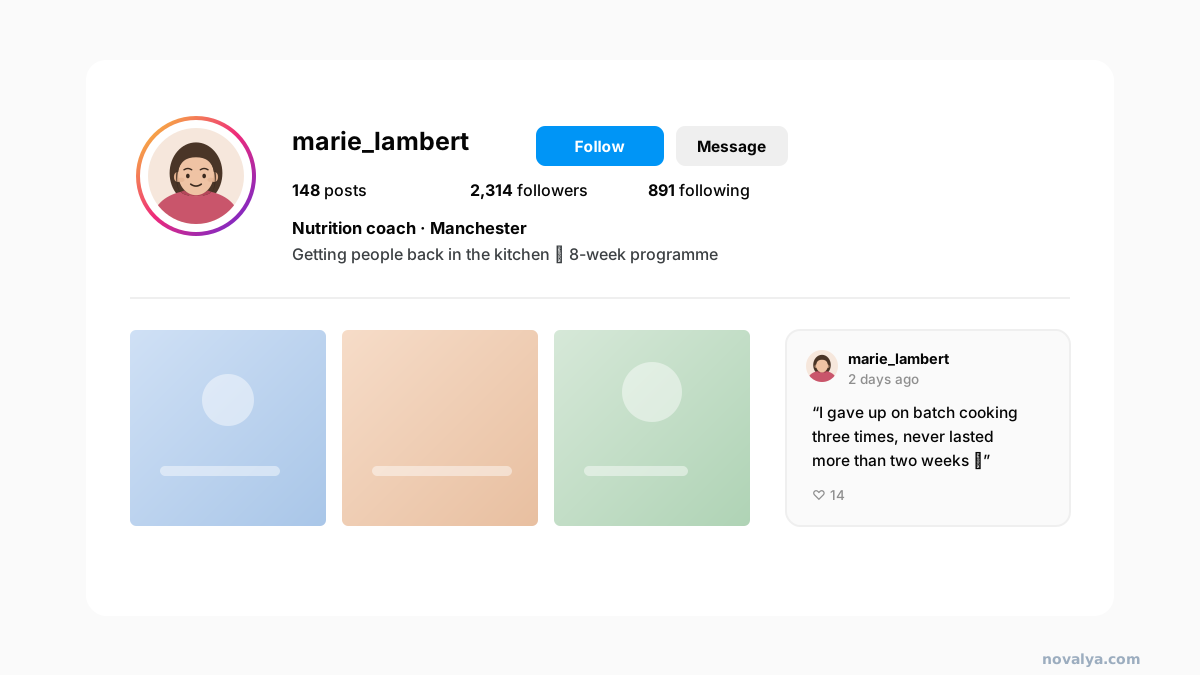
10 seconds reading a profile. That is the entire difference between these working and not working, and it is the step that separates an opener someone answers from one they scroll past without thinking about it.
The 30-second test
Open the profile before you write anything. If you cannot find one concrete detail — a post, a comment, a city, a result — in 30 seconds, this is not your prospect. Skip them. It costs you nothing and it saves the message. ✨
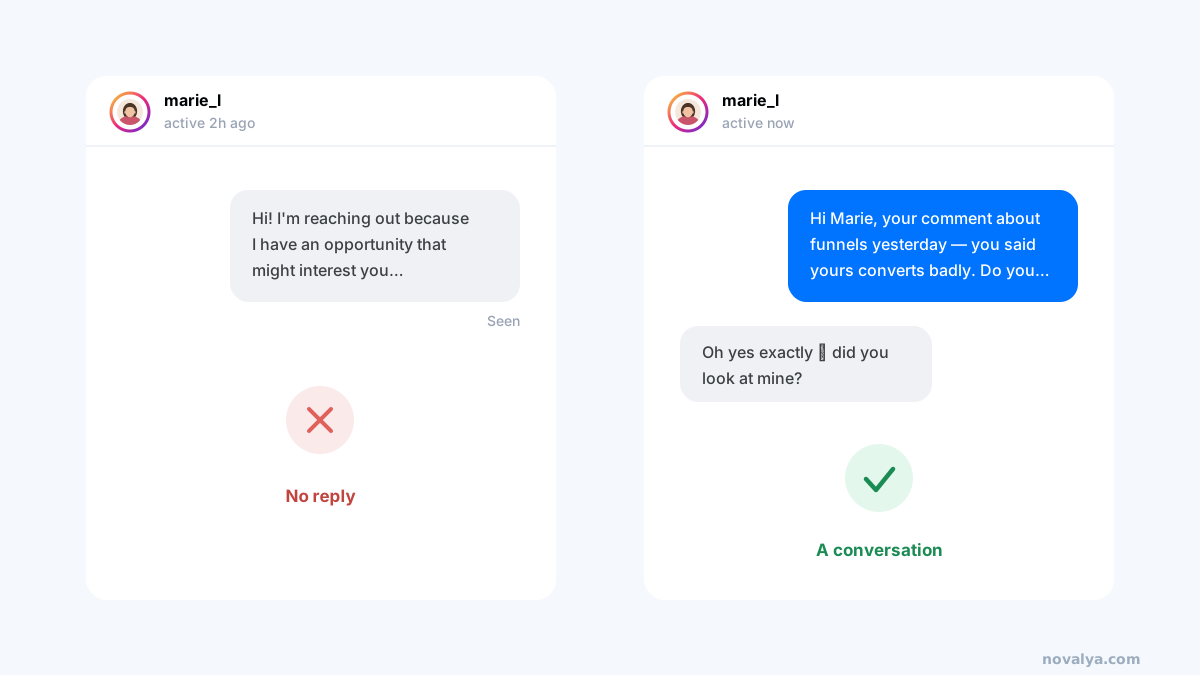
1. The comment callback
Use it when: they commented on a post about the problem you solve.
Hi [name], saw your comment on [post subject] in [group] — you said [what they actually wrote]. Out of curiosity, how are you handling that at the moment?
Why it works: you are not a stranger, you are someone who was in the same room. And you ask about their situation instead of announcing yours.
Fill in yourself: their exact words. Quoting the comment is the whole message.
2. The recommendation intercept
Use it when: they publicly asked for a recommendation.
Hi [name], saw you asking about [the thing] earlier — I do this every day, happy to tell you what I'd check before picking one. What matters more to you, [criterion A] or [criterion B]?
Why it works: 🎯 this is the highest intent that exists on social. They asked. You answer, and the closing question makes replying easier than not replying.
Fill in yourself: 2 criteria that genuinely matter in their case. Generic ones give the message away.
3. The specific compliment
Use it when: you have no shared context, but their profile hands you something real.
Hi [name], your [specific thing — a post, a result, a project] stuck with me, the [detail] especially. How long have you been doing [that]?
Why it works: the detail proves a human looked. "Love your content" proves the exact opposite, and it is the fastest way to be ignored. 😬
Fill in yourself: the detail. No detail in 30 seconds, no message.
4. The common ground
Use it when: you share a group, a client, a city, a background.
Hi [name], we're both in [the shared thing] — noticed you [what they do]. I work with [who you help] on [what], so I keep an eye on what people in [the shared thing] are up to. What are you working on this quarter?
Why it works: shared context lowers the guard, and it hands them an easy hook if they feel like replying.
Fill in yourself: the shared thing has to be true and checkable. Invent one and you lose the conversation on message 2.
5. The reactivation
Use it when: you already spoke, months ago, and nothing came of it.
Hi [name], we spoke back in [month] about [subject] — you were [their situation at the time]. Did that ever move?
Why it works: this is the highest-reply message on the list and almost nobody sends it. 🤯 You already have permission, you already have the context, and "did that ever move?" is genuinely easy to answer.
Fill in yourself: what the old conversation was actually about. This is why keeping notes on your contacts pays for itself.
6. The occasion
Use it when: something is happening — a birthday, an anniversary, a new role, a launch.
Happy birthday [name] — hope you get to switch off today.
That is the whole message. No question after it, no pivot, nothing about you.
Why it works: because it asks for nothing. It reopens a thread you can use in 2 weeks, and people remember who wrote. Adding a pitch underneath destroys the only thing that made it work.
Fill in yourself: nothing. Just resist the second sentence. 🙃
7. The referral ask
Use it when: they are not your buyer, but they know your buyers.
Hi [name], you're not the kind of person I'd usually reach out to — you work with [audience], and I help [audience] with [problem]. If you ever hear someone complaining about [problem], I'd like to be the person you send them to. And on your side, anything I can keep an eye out for?
Why it works: it takes the sales pressure out completely, which is exactly what makes people willing to engage. 🤝 And it ends on an offer instead of a request.
Fill in yourself: the audience overlap has to be real, or the message reads as a pitch in a costume.
The 5 mistakes that kill all 7
A link in the first message
The most reliable way to get marked as spam, on any platform. Nothing you are sending is worth that. 😬
The link belongs in the second message, once they have replied — and it goes in because they asked for it. 🙌
A pitch before the reply
You have not earned it yet. And it is precisely what generates the reports that get accounts restricted.
A question that takes work to answer
"What are your biggest challenges right now?" demands an essay from someone who owes you nothing.
One sentence. Answerable in 10 seconds. Otherwise you are not asking a question, you are setting homework. 😅
Identical text at volume
Detectable, obviously. But the real cost is human: people forward these to each other and laugh about them. A screenshot of your message inside a group costs you more than a block ever will.
Sending before reading
If you have not looked at the profile, do not send. All 7 templates above collapse into spam without their variable. 👇
Volume is not the fix for a low reply rate, and it is the first lever everyone reaches for. Before you touch the number of messages you send, read how many DMs you can send on Instagram per day — the ceiling is set by your behaviour, not by a setting.
They replied. Now what?
This is where most people lose what they just earned. A reply is not a green light to sell, it is a door left slightly open.
What closes the door
Going straight to what you sell. Sending a booking link. Asking 3 questions at once.
They replied out of politeness or curiosity. They did not ask for a meeting.
What keeps it open
Bounce off what they just said, and ask one more question. Then another one in the message after that. 😍
3 exchanges before you propose anything. It is slow, and it is the whole difference. 💪
One simple rule: never propose anything until they have asked a question about you. Until they want to know what you do, you are still earning the conversation.
The second message is easier than people expect, because they have just handed you the material for it. Take the specific thing they mentioned, ask what they tried about it, and stop there. You are not qualifying anyone yet; you are finding out whether there is a real problem worth talking about at all.
And keep a record. Template 5 — the reactivation — is the most profitable one on this list, but it only exists if you know what you talked about 6 months ago. 💡
The uncomfortable part
These templates are not the hard part.
The hard part is doing the 10 seconds of reading every single time, for the 200th person this month. That is exactly where everyone quietly starts skipping it, and exactly when the results stop. 🔥
Which is why the honest version of this page is a trade rather than a shortcut: you can send fewer messages and read every profile, or send more and read none of them, and only the first of those two has ever filled anyone's pipeline.
If you take one thing from this page, take this: the template is 20% of the result. The variable you fill in yourself is the other 80%.
The short version
- A first message has one job: get a reply. Not a sale, not a booked call.
- The template is 20%, the variable is 80%. 10 seconds on the profile, every time.
- Never a link and never a pitch in the first message. That is what triggers the reports, and reports are what get accounts restricted.
- A question answerable in 10 seconds, not an essay prompt.
- 3 exchanges before you propose anything, and never before someone has asked a question about you.
Frequently asked questions
How many of these can I send per day?
No platform publishes a number, and the thresholds circulating online are sourced nowhere. What decides is your account age, how much your wording varies, and your reply rate — we went through it in how many DMs you can send on Instagram per day.
Do I personalise the whole message or just the first line?
The first line is enough, and it is the only one that really counts. It is what shows up in the notification, before the message is even opened. The rest can be identical from one person to the next without anybody noticing.
Can I automate these templates?
The text and the sending, yes. The bracketed variable, no — that is the part that earns the reply. A tool that claims to fill it for you produces generic copy in disguise, and generic copy gets reported.
What do I do if nobody replies?
Look at your first line before anything else. If it could have been sent to anyone, that is where the problem is, not in the volume. A low reply rate never gets fixed by sending more; that only speeds up the reports.
Where do I find people worth sending these to?
Somewhere they have already said something in public, because that is what makes the variable easy to fill. Facebook groups are still the clearest example — how to find and message prospects in a Facebook group covers which groups to join and which members to write to.
Read next
- FFacebook OutreachHow to find clients on Facebook without running adsSix ways to get clients on Facebook without an ad budget — where to find people, what to send first, and how to keep track of the conversations.
- IInstagram OutreachInstagram "Action Blocked": what it actually meansWhy Instagram shows "Action Blocked", what can trigger it, how long it lasts, and whether it means your account is banned.
- PProspecting ToolsWhat an Instagram prospecting tool actually doesWhat an Instagram prospecting tool actually automates, what it can't do, and the 4 things worth checking before you pick one.