
Prospecting in a Facebook group: the 4-step method
You joined a handful of Facebook groups full of people who look exactly like your customers, and now you are staring at a member list with no idea how to approach anyone without getting thrown out. 👀
The short answer
A Facebook group is one of the few places where strangers say out loud, in public, what interests them, what they are stuck on and what they are trying to buy. That is the information an ad platform charges you to guess at. The catch is that you have to write to the right people, in the right order.
Most people work groups badly. They join 20, post a link, get removed from 6, and conclude that groups do not work.
In this article, the 4 steps of the version that does work: how to pick a group, who to message first, what to prepare before you send anything, and what belongs in the first message.
Step 0 — Where to find groups worth the effort
Before you can choose, you need something to choose from, and Facebook's search bar is the worst tool for that job: it hands you the biggest groups, and the biggest ones are usually the deadest.
Three places work better. 🔍
The groups your own customers are in. Open the profiles of the last 3 people who bought from you and read the public groups they display. Your best customers hang out in the same rooms — the cheapest piece of research in this job, and the one almost nobody bothers to do. ✨
The suggestions inside a group you already belong to. Facebook shows related groups under posts and in the sidebar. Those beat the search bar because they are built on what members actually do, not on keywords in a group name.
Google rather than Facebook. A search for site:facebook.com/groups plus your topic surfaces groups the internal search never shows you, and it comes with a free signal: a group with indexed content is a group with public activity.
Aim for a shortlist of 10 candidates, not 3. You will keep 3 of them after step 1, and that is not a waste — the sorting is the work. 💪
Step 1 — Choose fewer groups, and choose them on activity
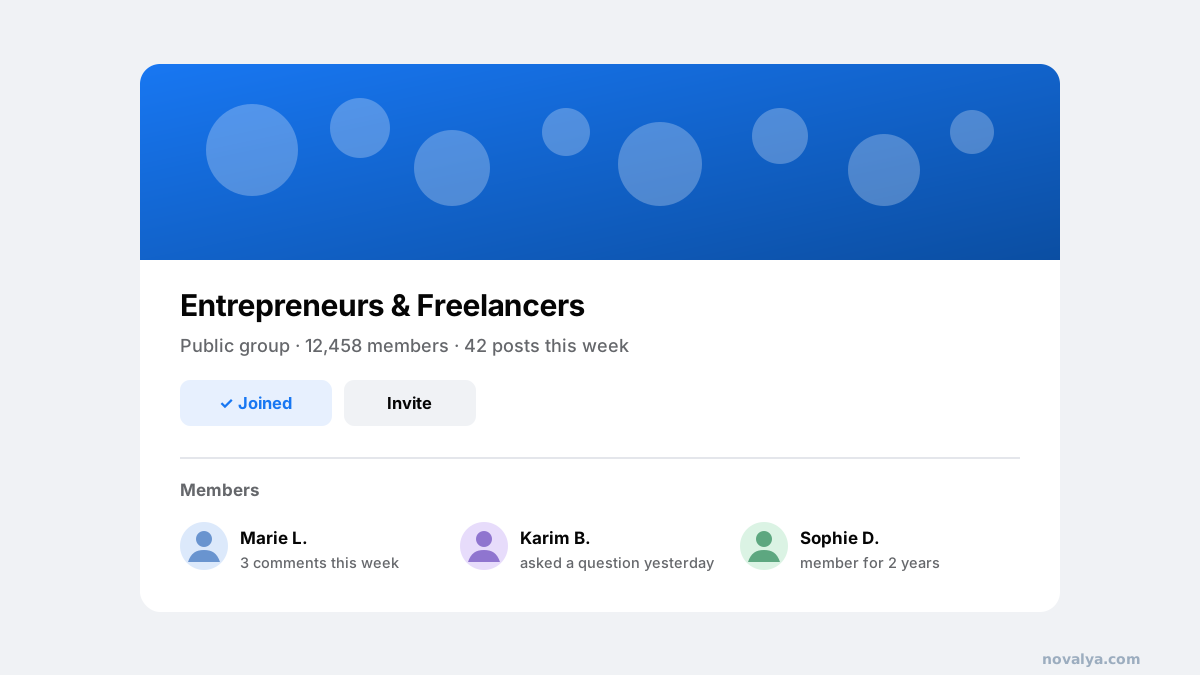
Member count is the least useful number on the page. A group of 80,000 members with 4 posts a week is a graveyard; a group of 3,000 with 30 posts a day is a market.
Here is what to look at instead:
- Posts in the last 24 hours. If you cannot find a dozen, move on to the next candidate.
- Comments per post. A group where posts collect 2 likes and no comments has an audience, not a community. You want the comments, because that is where people say things you can respond to.
- Whether the members are your buyers or your competitors. A group full of other people selling what you sell is a networking group. It has its uses; it is not a prospecting list.
- The rules. Read them, including the pinned post. Some groups forbid messaging members outright, and ignoring that gets you removed and reported in the same minute.
You cannot run this check from outside a private group — member activity only becomes visible once you are in. Request to join, then run the same 4 checks inside and leave again if it fails. Leaving a dead group costs you one click.
Three good groups you genuinely take part in will beat 30 you lurk in. 🔥
Step 2 — Message the people who act, not the whole list
The instinct is to open the member list and work down it. That is the worst possible order. 😬
Members are people who joined once, sometimes years ago, and may not have opened the group since. Commenters were there this week and cared enough to type. The gap in reply rate between those two groups is not a rounding error.
In priority order:
- People who commented on a post about the exact problem you solve. They described their situation in their own words, in public, and you can quote it back to them.
- People who posted asking for a recommendation. The strongest intent available anywhere on the platform, and usually the most contested — speed matters here.
- People who reacted to those posts. A weaker signal, a much bigger pool.
- The general member list. Last, and only once the first 3 are exhausted.
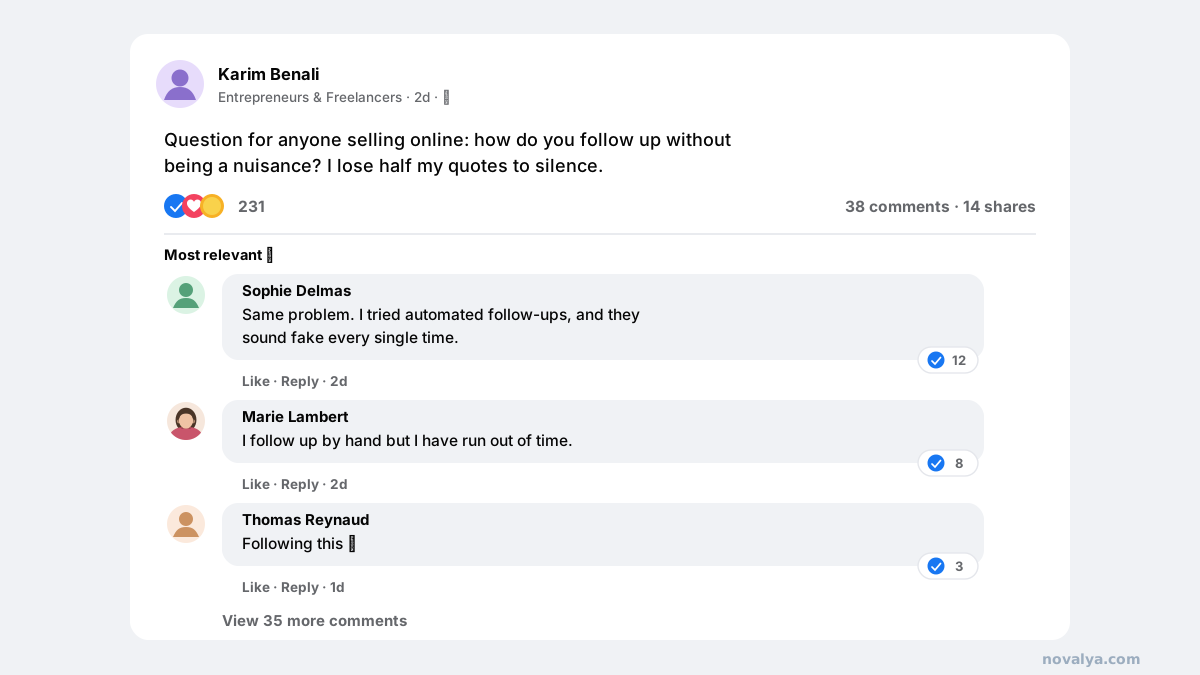
One busy thread is usually a full day of work. A post like "how do you follow up without being a nuisance?" can pull dozens of comments, and the first few already sort themselves: 2 people describing their own situation in detail, 1 who is only following the thread. The order is written for you. 😮
Step 3 — Warm the ground before you write
Two moves cost you nothing and change your reply rate more than any message template ever will.
Leave a real comment first. Not "great post" — an actual answer to what the person asked. When your name lands in their inbox the next day, it is no longer a stranger's name. This is the highest-leverage habit in group prospecting and almost nobody has it. 💡
Look like someone worth replying to. Your profile picture, your cover image and the first line of your bio are the whole of your credibility at the moment somebody decides whether to open your message. If your profile is a logo and a link, expect to be treated like an advert.
Comment today, write tomorrow
The gap is the point. A comment and a message in the same 5 minutes reads as a tactic; a day apart, it reads as a person who was already around. 🤝
Step 4 — What to put in the first message
The first message has exactly one job: get a reply. Not a sale, not a call, not a click. A reply.
Which means:
- Quote the specific thing they said, in the group, in their words. This is what separates a message from a broadcast, and it is the part no software can invent for you.
- Ask one question they can answer in a sentence. Open questions that need an essay get ignored by busy people who were otherwise interested.
- Do not pitch. Not in message 1. You have not earned it yet, and pitching is what generates the reports that get accounts restricted.
- Do not send a link. Until the person has replied, a link adds nothing and costs a lot: it is the single thing most likely to trigger the "report" reflex.
Sent to 40 members at once
"Hi! I help people like you get more clients with a simple system — want to know more?" Nothing in it proves a human read anything. Two members compare notes, one posts the screenshot in the group, and you lose every member at the same time.
Sent to 1 person who commented
"You said under Marie's post that you follow up twice and then feel like a pest — what does your second message actually say right now?" One question, answerable in one line, no link, no pitch.
If you cannot write a first line that could only have been sent to that one person, you are not ready to send it. For openers to work from, we broke down 7 first-DM templates that actually get a reply.
The first 3 days in a new group
Joining and messaging on the same day is the fastest way to get thrown out. An admin sees your join date, your post count and every report against you. An account that arrives and immediately starts sending is the profile they watch for.
Day 1 — you read, you say nothing
Go through the last 2 weeks of posts. You are looking for 3 things: what people complain about, who answers questions, and what the admin cracks down on.
By the end of it you will know whether this group is a market or a waiting room.
Day 2 — you comment, and you sell nothing
Two or three real answers to real questions. Not "great post". Something useful, even short, even when there is nothing in it for you. 💙
This is the move that makes everything after it work: the next day, your name no longer arrives as a stranger's.
Day 3 — you write, to the people who have seen you
Start with the people whose posts you commented on. They saw your name yesterday, in a context where you were helping.
The rest of the list can wait until next week.
Three days sounds like a long time when you have a number to hit. Weigh it against the cost of the other route: losing a group means losing every member of it at once, permanently, with no appeal to an admin who has already made up their mind.
The 5 mistakes that get you removed by an admin
Posting your offer in the group
Unless the rules explicitly invite it. It irritates the members and it gets you removed by the admin, which costs you the whole group instead of one prospect.
Mass-adding people as friends
Friend requests to strangers who decline or ignore them are one of the most heavily policed signals on Facebook — far more than messages. ⚠️
Sending everyone the same text
Members of a group talk to each other. Two identical messages and one screenshot in the feed is all it takes, and that screenshot is what an admin acts on, not your intentions.
Working 5 groups in one sitting
Volume in a burst is exactly the pattern that gets flagged. Spread it across days.
Skipping the follow-up record
If you cannot say who you have already contacted, you will eventually write to the same person twice — the most damaging thing you can do to your own credibility.
Where a tool fits
The manual version of all this works. It is also slow: opening the group, reading the comments, checking each profile, writing the note, remembering who you already spoke to.
Novalya takes over the mechanical half:
- Pulling the members of a group into a list you can filter.
- Varying the message, so no two people ever receive the same text.
- Spacing the sends out instead of firing them one after another.
- Skipping open conversations, and tracking every contact in a pipeline so nobody gets written to twice.
Each plan also sets a monthly message cap that you choose when you subscribe. The figures live on the pricing page, which is the only source that stays current when the plans move.
What it deliberately does not do is write your opening line from what somebody said in a comment. That sentence is the entire reason the message works, and it is worth your 10 seconds. 😉
What group prospecting actually looks like
Done properly, it is a channel that builds slowly, not a switch you flip. A good week is a handful of real conversations, not 50.
The people who make it work treat a group as a room they belong to rather than a list to be processed. 🙌
And it is no coincidence that those are also the accounts that never get restricted.
In short
- Three good groups beat 30 you lurk in. Judge on posts in the last 24 hours and comments per post, never on member count.
- Message the commenters, not the member list. They were there this week and they said something you can quote.
- Leave a real comment before you write privately. The highest-leverage habit in group prospecting, and almost nobody has it.
- No link and no pitch in the first message. That is what triggers the reports.
- Read the rules. Some groups forbid messaging members, and ignoring that gets you removed and reported at once.
Frequently asked questions
How many messages can I send a day from a group?
Facebook publishes no number, and volume is not what decides — pace and your reply rate are. The mechanism is the same one Instagram uses, and we took it apart in how many DMs can you send on Instagram per day?
Can I get banned for prospecting inside a group?
The realistic risk is not a ban, it is an admin removing you from the group — much faster and far more common. On the platform side, mass friend requests weigh heavier than messages do. The detail is in does Instagram ban you for automating DMs? — Meta judges the account's behaviour, not the tool.
Should I send a friend request before messaging?
No. The friend request is the most heavily watched gesture of the two, and it adds nothing a well-written message does not already do. Write directly, quoting what the person posted.
What do I do if the group admin spots me?
Stop in that group immediately, and do not come back at it from another angle. An admin who reports you to Facebook carries far more weight than a member who ignores you. Move to the next group and apply step 3 this time.
How many groups should I work at the same time?
Two or three, and never in the same sitting. Beyond that you stop being a participant anywhere, which is the thing that made the method work in the first place.
Read next
- FFacebook OutreachHow to find clients on Facebook without running adsSix ways to get clients on Facebook without an ad budget — where to find people, what to send first, and how to keep track of the conversations.
- IInstagram OutreachInstagram "Action Blocked": what it actually meansWhy Instagram shows "Action Blocked", what can trigger it, how long it lasts, and whether it means your account is banned.
- PProspecting ToolsWhat an Instagram prospecting tool actually doesWhat an Instagram prospecting tool actually automates, what it can't do, and the 4 things worth checking before you pick one.